



Liquid Crystal Display
What is a Liquid Crystal Display (LCD)?
A Liquid Crystal Display (LCD) is a flat-panel display technology widely used in electronic devices such as calculators, televisions, laptops, digital watches, and smartphones. It works by using the light-modulating properties of liquid crystals that do not emit light directly but instead use a backlight or reflector to produce visible images.
How Does an LCD Work?
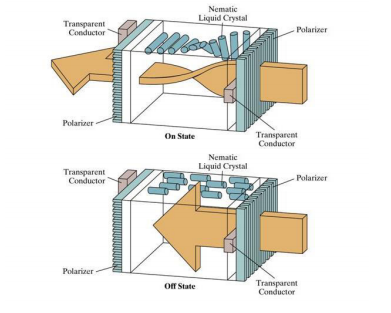
The working principle of an LCD is based on the polarization of light and the alignment of liquid crystal molecules. Here’s a simplified breakdown:
-
Backlight Source – Provides illumination.
-
Polarizer Filters – Control the orientation of light waves.
-
Liquid Crystal Layer – Molecules align when an electric current passes, controlling light passage.
-
Color Filters – Generate red, green, and blue (RGB) colors.
-
Display Output – The combined effect creates images on the screen.
When no current is applied, the liquid crystals block or twist light. When voltage is applied, they align differently, allowing light to pass and form images.
Advantages of LCD
-
Low Power Consumption – Consumes less energy compared to CRT displays.
-
Slim and Lightweight – Ideal for portable and compact devices.
-
High-Quality Display – Produces sharp, flicker-free images.
-
Less Heat Generation – Energy-efficient and safe for long usage.
Applications of LCD
-
Consumer Electronics: Smartphones, tablets, televisions, monitors.
-
Digital Instruments: Calculators, digital watches, medical equipment.
-
Industrial Displays: Control panels, automotive dashboards.
-
Aerospace and Defense: Cockpit displays, navigation systems.
Future of LCD Technology
Though OLED and LED displays are gaining popularity, LCDs continue to dominate in affordability, durability, and mass usage. With advancements like IPS (In-Plane Switching) and TFT (Thin Film Transistor), LCD technology has significantly improved in terms of brightness, viewing angles, and response time.