



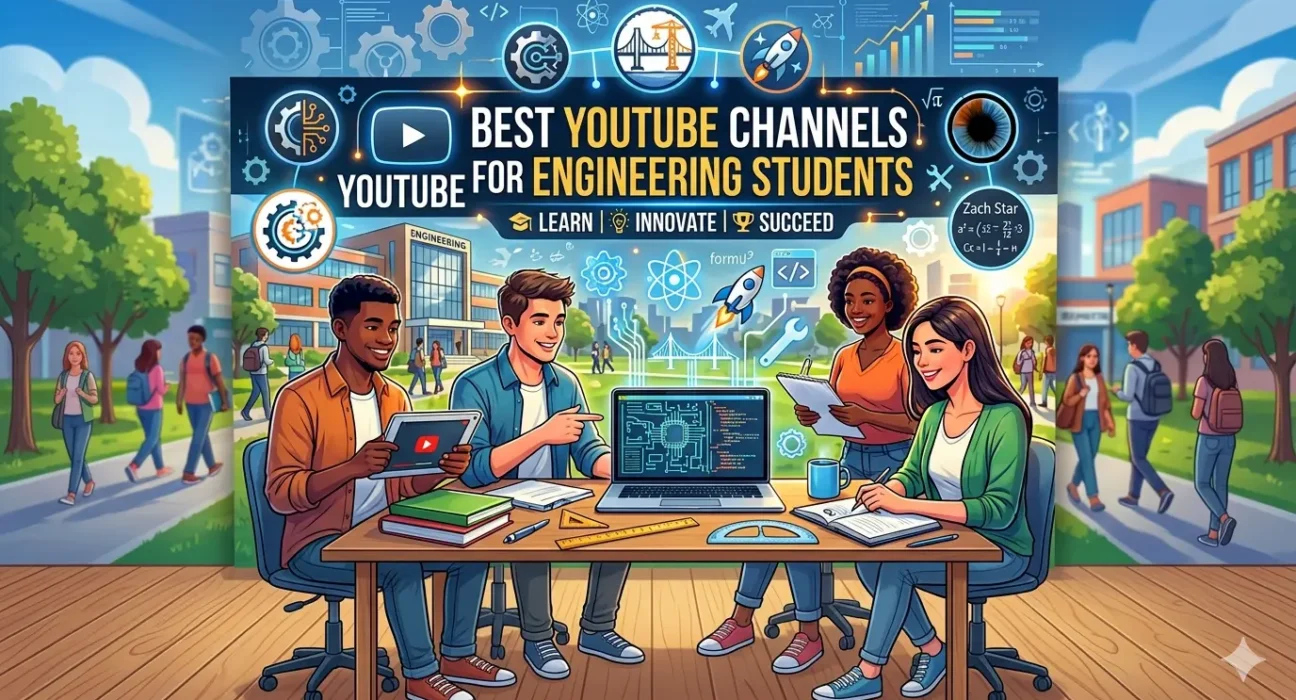
Best YouTube Channels for Engineering Students
Introduction
Your textbook explains what a pointer is. A great YouTube channel shows you exactly why it matters — with animations, real examples, and a teacher who clearly loves the subject.
That single difference changes everything about how fast you learn.
In 2026, world-class engineering education is available to every student — completely free — on YouTube. The challenge, however, is not finding content. There is more engineering content on YouTube than any student could consume in a lifetime. The real challenge is finding the channels that consistently deliver accurate, well-explained, and genuinely useful content.
This guide solves that problem. Below are the 10 best YouTube channels for engineering students in 2026 — what each one teaches, who benefits most, exactly which playlist to start with, and a direct link to every channel.
Why YouTube Has Become Essential for Engineering Students in 2026
Engineering concepts are spatial, sequential, and deeply visual. A page of text explaining how a sorting algorithm works is useful. Watching that same algorithm animate step by step — with every comparison highlighted and every swap shown in real time — produces understanding at an entirely different level.
Furthermore, the best YouTube educators in 2026 combine university-level rigour with conversational clarity that most textbooks never achieve. They pause to build intuition, not just procedure. They connect concepts across topics. Moreover, they answer the question that textbooks almost never address — why does this actually matter?
Consequently, millions of engineering students now use YouTube not as a replacement for formal education but as its most powerful complement — filling the gaps that lectures leave and deepening the understanding that syllabi only skim.
1. Abdul Bari — Best for DSA and CS Core Subjects
🔗 Channel: youtube.com/@abdul_bari Best For: CSE, IT, and all engineering students preparing for placements and GATE Key Topics: Algorithms, Data Structures, Operating Systems, DBMS, Computer Networks
If there is one YouTube channel that every engineering student in India knows and trusts, it is Abdul Bari.
His explanations of algorithms and data structures are, quite simply, the clearest available anywhere on the internet. He does not rush. He never assumes prior knowledge. Instead, he builds each concept from first principles, explains the intuition behind it, works through examples manually, then transitions naturally to code.
What makes his teaching particularly effective is his habit of connecting theory to practice. After explaining how an algorithm works conceptually, he walks through time complexity analysis, discusses when to apply it, and clarifies the misconceptions that typically trip students up in exams and interviews.
His operating systems, DBMS, and computer networks playlists are equally outstanding. Together, these four topics cover the foundation of almost every technical interview at Indian IT companies and product firms.
Start Here: Open the Algorithms playlist. Watch the videos on Time Complexity and Recursion back to back. These two topics underpin everything else he teaches — and everything that technical interviews test.
2. 3Blue1Brown — Best for Mathematical Intuition
🔗 Channel: youtube.com/@3blue1brown Best For: Students who want to truly understand mathematics, not just apply formulas Key Topics: Linear Algebra, Calculus, Neural Networks, Probability, Fourier Transform
Grant Sanderson created 3Blue1Brown with one mission — make mathematics feel intuitive rather than mechanical. In 2026, it has become the gold standard for visual mathematical explanation. For engineering students, it is genuinely transformative.
The “Essence of Linear Algebra” series is particularly important. Rather than drilling formulas, it shows you what each operation looks like geometrically. As a result, concepts that feel abstract and arbitrary on paper suddenly make complete visual sense. Vectors, matrices, eigenvalues, and transformations all click into place in a way that classroom teaching rarely achieves.
For AI and machine learning students, the “Neural Networks” series is outstanding. It builds from perceptrons to backpropagation using animations that reveal what the mathematics is actually doing inside a network — something most deep learning courses skip entirely.
Start Here: Watch the “Essence of Linear Algebra” series before you take any machine learning course. The geometric intuition it builds makes everything that follows significantly easier to understand.
3. MIT OpenCourseWare — Best for University-Level Depth
🔗 Channel: youtube.com/c/mitocw Best For: Students who want genuine IIT/MIT-level content, completely free Key Topics: Algorithms, AI, Mathematics, Circuits, Thermodynamics, Fluid Mechanics, Systems
MIT OpenCourseWare on YouTube is exactly what it sounds like — full lecture recordings from actual MIT courses, made freely available to every student on earth.
The channel covers every major engineering discipline. CSE students find complete courses on algorithms, artificial intelligence, operating systems, and software engineering. Electrical engineering students access circuits, signals, and systems content at MIT’s standard. Mechanical and civil engineering students find thermodynamics, fluid mechanics, and structural analysis taught with genuine rigour.
Moreover, MIT OCW videos do not water things down. They are real university lectures — challenging, precise, and dense with insight. Working through a complete MIT lecture series builds the kind of structured, deep understanding that makes you genuinely better at your subject — not just better at passing exams.
Start Here: CSE students should begin with “Introduction to Algorithms (6.006).” Electrical engineering students should start with “Circuits and Electronics (6.002).” Both are exceptional entry points.
4. Neso Academy — Best for Engineering Core Semester Subjects
🔗 Channel: youtube.com/@nesoacademy Best For: Electronics, Electrical, and CSE students studying core semester subjects Key Topics: Digital Electronics, Signals and Systems, Computer Networks, Operating Systems, C Programming
Neso Academy is arguably the most comprehensive free resource on YouTube for core engineering subjects — particularly for Electronics and Communication students who often struggle to find quality video content aligned to their syllabus.
The channel explains digital electronics, signals and systems, control systems, microprocessors, and computer networks with exceptional clarity. Each concept gets its own short, focused video — making it easy to target exactly what you need rather than sitting through long lectures searching for a 10-minute explanation.
For CSE students, the computer networks and operating systems playlists are outstanding. They align closely with university syllabi across most Indian universities and cover exactly the topics that appear in GATE, campus placements, and semester exams.
Furthermore, Neso Academy videos follow a logical, systematic progression. Working through any playlist in sequence gives you a genuinely complete understanding of the subject — not isolated facts stitched together randomly.
Start Here: EC and EE students should begin with “Digital Electronics.” CSE students should start with “Computer Networks” — it is one of the most complete free treatments of the topic available anywhere online.
5. Traversy Media — Best for Full-Stack Web Development
🔗 Channel: youtube.com/TraversyMedia Best For: CSE and IT students who want to build real web projects for their portfolio Key Topics: HTML, CSS, JavaScript, React, Node.js, Python, REST APIs, MongoDB
If you want to learn web development by actually building real things — rather than watching someone explain abstract concepts — Traversy Media is the channel you need.
Brad Traversy’s teaching style is direct and practical. He shows you how to build complete, real projects from start to finish. Rather than spending time on pure theory before touching code, he starts building almost immediately. Explanations arrive in context — as each new concept becomes necessary to move the project forward.
The channel covers the full modern web development stack. Front-end topics like HTML, CSS, JavaScript, and React sit alongside back-end topics including Node.js, Express, Python, and database integration. Additionally, his crash course videos are particularly efficient — each one delivers a genuinely useful overview of a technology in under two hours.
For Indian engineering students targeting web development roles during campus placements or applying to startups, the portfolio projects built through Traversy Media tutorials directly strengthen your resume.
Start Here: Watch “HTML and CSS Crash Course” followed immediately by “JavaScript Crash Course.” Then build the first complete project tutorial you find interesting — the project matters more than the view count.
6. CS Dojo — Best for Interview-Focused DSA and Python
🔗 Channel: youtube.com/c/CSDojo Best For: Students preparing for technical interviews at product and service companies Key Topics: Data Structures, Algorithms, Python, Interview Strategy, Problem-Solving
CS Dojo occupies a specific and genuinely valuable niche among engineering YouTube channels. It focuses almost exclusively on what actually matters in coding interviews — and explains it in a way that is calm, clear, and remarkably accessible even for anxious beginners.
The “Data Structures and Algorithms” playlist is especially strong. It covers arrays, linked lists, trees, graphs, hash tables, and sorting algorithms with clear Python implementations and honest explanations of when each structure is the right choice.
Furthermore, the channel includes practical interview strategy content — how to approach a problem you have never seen before, how to think out loud effectively during a technical interview, and how to avoid the common mistakes that knock otherwise strong candidates out of the hiring process.
For students preparing for their first technical interviews at MNCs or product companies, CS Dojo provides exactly the preparation framework needed — focused, practical, and realistic about what the process actually demands.
Start Here: Watch the “Data Structures and Algorithms for Beginners” playlist from the very first video. Code along in Python as you go — passive watching alone will not build the muscle memory that interviews require.
7. Andrej Karpathy — Best for AI and Neural Networks at Depth
🔗 Channel: youtube.com/@AndrejKarpathy Best For: CSE students pursuing AI, ML, or deep learning specialisations Key Topics: Neural Networks, Large Language Models, Backpropagation, Transformers, GPT Architecture
Andrej Karpathy is, in 2026, the most respected AI educator on YouTube. His approach is distinctive — he builds everything from scratch, from first principles, so you understand not just how neural networks behave but exactly why they work the way they do.
His “Neural Networks: Zero to Hero” series is the clearest explanation of how modern AI systems — including large language models — actually function under the hood. Rather than relying on high-level abstractions, he implements a neural network from scratch, walks through backpropagation line by line, and progressively builds toward a simplified version of a GPT-style language model.
Additionally, his explanations are unusually honest about genuine complexity. He does not pretend that hard things are simple. Instead, he makes genuinely difficult ideas accessible through careful, patient, step-by-step reasoning.
Notably, in 2026, Karpathy joined Anthropic’s pretraining team — making his educational content even more relevant for students who want to understand cutting-edge AI research from someone actively working at the frontier.
Start Here: Watch “The spelled-out intro to neural networks and backpropagation: building micrograd.” It runs for about two and a half hours — and every minute of it is worth your full attention.
8. The Engineering Mindset — Best for Non-CSE Core Engineering
🔗 Channel: youtube.com/channel/UCk0fGHsCEzGig-rSzkfCjMw Best For: Mechanical, Electrical, Civil, and HVAC engineering students Key Topics: Electrical circuits, HVAC systems, thermodynamics, fluid mechanics, motors, transformers
Not every engineering student studies computer science. For those in mechanical, electrical, civil, and related disciplines, The Engineering Mindset is one of the most consistently useful YouTube channels available in 2026.
The channel specialises in explaining how real engineering systems actually work — not just the theory, but the practical application. Topics like how transformers transfer power, how HVAC systems maintain building temperatures, how electric motors generate torque, and how fluid mechanics applies to real pipe systems are all explained with clear animations and real-world visuals.
Moreover, the production quality is exceptional. Diagrams are detailed, animations are accurate, and explanations avoid unnecessary jargon without ever sacrificing technical correctness. The result is content that feels professional and reliable — the kind you can confidently use to supplement your university coursework.
For non-CSE students who feel underserved by most engineering YouTube content — which skews heavily toward programming and CS topics — The Engineering Mindset fills a genuine and important gap.
Start Here: Mechanical and civil students should begin with “Fluid Mechanics” or “Thermodynamics.” Electrical students should explore the “Electrical Engineering” playlist — it is detailed, accurate, and exceptionally well-animated.
9. Krish Naik — Best for Data Science and Machine Learning
🔗 Channel: youtube.com/channel/UCNU_lfiiWBdtULKOw6X0Dig Best For: Students pursuing data science, AI, or machine learning career paths Key Topics: Python for Data Science, Machine Learning, Deep Learning, NLP, MLOps, Generative AI
Krish Naik is one of the most prolific and trusted data science educators on Indian YouTube. In 2026, his channel remains the go-to starting point for engineering students moving from programming basics into practical machine learning and data science.
What distinguishes his content is the combination of breadth and applied focus. He covers Python fundamentals, exploratory data analysis, machine learning algorithms, deep learning frameworks, natural language processing, and even MLOps — the process of deploying machine learning models into real production environments that most courses never address.
Additionally, Krish Naik updates his content regularly to reflect what industry actually uses. His 2026 content on Generative AI, Large Language Model fine-tuning, and RAG (Retrieval-Augmented Generation) systems reflects current industry practice rather than textbook concepts from three years ago.
For CSE and IT students targeting data science or AI roles during placements, his channel provides the most complete free curriculum available — delivered in both Hindi and English.
Start Here: Begin with his Python for Data Science playlist if you are new to the domain. If you already know Python, jump directly to the Machine Learning playlist and follow it in full sequence from the first video.
10. Computerphile — Best for Deep CS Concepts and Theory
🔗 Channel: youtube.com/channel/UC9-y-6csu5WGm29I7JiwpnA Best For: Students who want deep, fascinating explanations of how computers and CS concepts actually work Key Topics: Cryptography, AI, Programming Languages, Networking, Security, Algorithms, Theory of Computation
Computerphile is unlike any other channel on this list. Rather than following a fixed curriculum or preparing you for a specific exam, it explores computer science concepts through in-depth conversations with real academics, researchers, and industry practitioners.
Each video tackles a single topic with genuine intellectual depth — how encryption actually works, why floating-point arithmetic produces surprising results, what makes some problems computationally unsolvable, how neural networks learned to generate realistic images, and dozens of other topics that university courses mention but rarely explain with real clarity.
Furthermore, the conversational format keeps things genuinely engaging. Watching a Computerphile video feels like sitting in on a conversation between a student and a brilliant professor — informal enough to stay interesting, rigorous enough to deliver real understanding.
In 2026, Computerphile’s growing content on AI safety, large language model limitations, and cybersecurity has become especially relevant for engineering students who want to understand not just how technology works but also where it can go seriously wrong.
Start Here: Search “Computerphile” combined with any topic you are currently studying. The channel has covered almost every CS topic imaginable — and nearly every video you find will be worth watching in full.
How to Use These Channels Together — A Practical Strategy
Knowing which channels exist is only half the answer. Using them strategically is what actually produces results.
Here is an approach that works for Indian engineering students in 2026.
Pair every video with immediate practice. Watch Abdul Bari explain an algorithm. Then solve a related problem on a coding platform right away. Watch Traversy Media build a project. Then modify it, extend it, or rebuild it from memory. The gap between watching and doing is where real understanding is either built or lost.
Use 3Blue1Brown before difficult courses, not after. Watching “Essence of Linear Algebra” before your machine learning course gives you geometric intuition that makes the mathematics land immediately — rather than remaining abstract until you cram before the exam.
Build a simple weekly rotation. Dedicate early weekdays to core subject content from Neso Academy or MIT OCW. Allocate mid-week time to problem-solving from Abdul Bari or CS Dojo. Use the latter part of the week for project-based work from Traversy Media or Krish Naik. Reserve weekend time for deeper curiosity-driven exploration through Computerphile or 3Blue1Brown.
Take brief, active notes. The goal of watching a YouTube video is not to transcribe what the creator says. Rather, it is to build understanding that you can later apply. A short bullet-point summary of what you genuinely understood — not what was said — is worth far more than three pages of copied lecture notes.
Frequently Asked Questions (FAQ)
Q1. Which is the best YouTube channel for engineering students in India in 2026? Abdul Bari is the most widely recommended channel for CSE and IT students, particularly for data structures, algorithms, and CS fundamentals. For non-CSE branches, The Engineering Mindset and Neso Academy offer equally strong content in electrical, mechanical, and electronics engineering.
Q2. Which YouTube channels are best for placement preparation in 2026? Abdul Bari and CS Dojo together form the strongest free YouTube combination for placement preparation. Abdul Bari covers theoretical CS fundamentals deeply. CS Dojo focuses on interview-specific problem-solving strategy using Python. Using both in parallel builds strong theory and strong practical skills simultaneously.
Q3. Is YouTube alone sufficient to learn engineering concepts without paid coaching? Yes — for consistent, self-disciplined students. Channels like MIT OpenCourseWare, Abdul Bari, and Traversy Media together cover theoretical foundations, core concepts, and practical project skills at a level that competes with paid coaching. The critical differentiator is daily practice alongside watching. Videos alone do not build skills — but videos combined with daily coding and project work absolutely do.
Q4. Which YouTube channel is best for AI and machine learning in 2026? Andrej Karpathy is the best choice for deep, foundational understanding of neural networks and large language models. Krish Naik is the best choice for applied, practical machine learning and data science in Python. For the mathematical foundations supporting AI, 3Blue1Brown’s “Neural Networks” and “Essence of Linear Algebra” series are essential companions to either channel.
Q5. Which channels cover mechanical and electrical engineering specifically? The Engineering Mindset is the strongest YouTube channel for mechanical, electrical, and HVAC engineering topics, with exceptionally clear animations and real-world examples. MIT OpenCourseWare covers electrical circuits, thermodynamics, and mechanical systems at university level. Neso Academy is excellent for Electronics and Communication students covering their specific syllabus topics.
Q6. How many YouTube channels should an engineering student follow at once? Two to three channels at a time is optimal for most students. Following too many simultaneously creates content overload without depth. A strong combination for CSE students is Abdul Bari for core concepts, Traversy Media or CS Dojo for practical skills, and 3Blue1Brown for mathematical intuition. Non-CSE students can replace the latter two with Neso Academy and The Engineering Mindset.
Conclusion
The best engineering education in 2026 does not always happen inside a classroom. Sometimes, it happens late at night when a student finally understands recursion after one clear, perfectly animated explanation at exactly the right moment.
That moment is available to every student — regardless of which college they attend, which city they live in, or which textbook their university prescribed.
However, the channels on this list are not shortcuts. They are tools. Like every tool, their value depends entirely on how consistently and deliberately you use them.
Watch. Pause. Code. Build. Break. Fix. Repeat.
That cycle — sustained consistently over months — produces engineers who genuinely understand their subject from the inside out. And in 2026, that depth of understanding is precisely what separates candidates who crack interviews from those who struggle past the first round.
Every channel link above is free, active, and ready. The only thing left is to press play and actually begin.