



Are Exams the Best Way to Judge a Student?
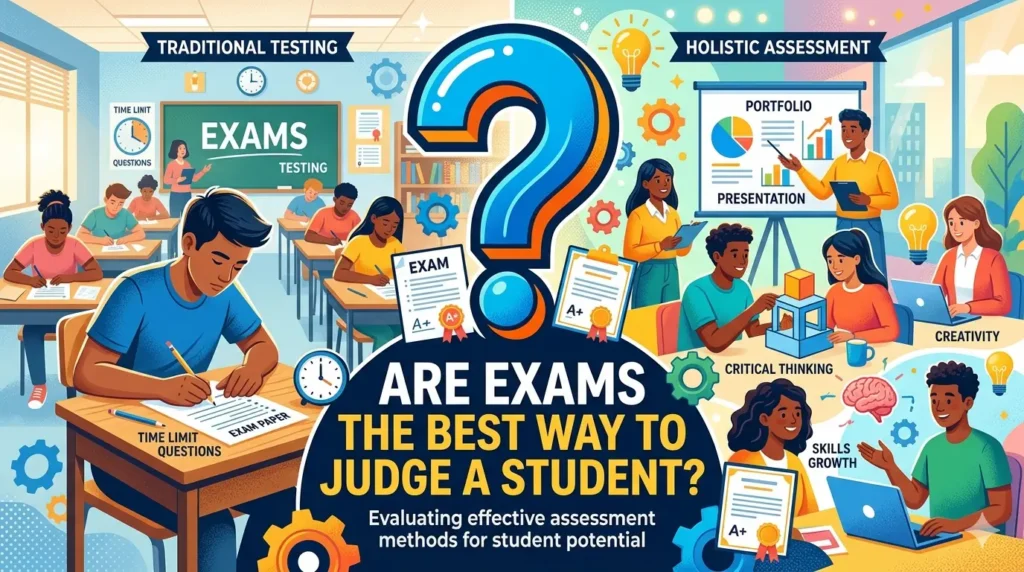
For generations, exams have remained the standard method of judging a student’s ability. A single test, often just a few hours long, decides how capable a student is considered to be. While this system has existed for years, it raises an important question. Are exams truly the best way to judge a student?
There are valid reasons why exams continue to hold their place in education.
Exams offer a fair and uniform way to measure students. Every student answers the same questions under the same conditions. This makes comparison simple and, in many ways, objective. Teachers and institutions can easily evaluate large numbers of students within a short time. Without such a system, judging thousands of students fairly would become incredibly difficult.
Exams also encourage discipline and preparation. Knowing that a test lies ahead, students often organise their study schedule and revise consistently. This habit of preparing under pressure can be valuable later in life, especially in situations that demand focus and time management. In this sense, exams do more than test knowledge; they also build certain life skills.
However, critics argue that exams capture only a narrow slice of a student’s true ability.
A single test cannot measure creativity, communication skills, or practical understanding. Some students grasp concepts deeply but struggle to express that knowledge within a fixed time limit. Others may perform poorly simply due to stress or anxiety, even if their actual understanding is strong. As a result, exams sometimes reflect a student’s performance under pressure rather than their genuine ability.
Exams also tend to favour memorisation over real understanding. Many students focus on memorising facts just to score well, rather than engaging deeply with the subject. Once the exam ends, much of this memorised information is quickly forgotten. This raises a serious concern. Does scoring well in an exam truly reflect meaningful learning, or does it simply reflect short-term recall?
Furthermore, every student is different. Some excel in art, sports, or practical skills, areas that traditional exams rarely assess. A student who struggles with written tests might be highly talented in other fields. By relying only on exams, schools risk overlooking such talents entirely. This narrow approach can affect a student’s confidence and limit their true potential.
Given these concerns, many educators now believe in a more balanced approach to evaluation. Continuous assessment, project work, group activities, and practical tests can offer a fuller picture of a student’s abilities. Combining these methods with traditional exams would allow both knowledge and skills to be judged fairly. This approach also reduces the immense pressure that often comes with a single, high-stakes exam.
In conclusion, exams remain a useful tool, but they should not be considered the only measure of a student’s true worth. Education is far too diverse to be judged through one method alone. A combination of exams, practical learning, and continuous evaluation would offer a much fairer and more complete understanding of a student’s abilities. After all, true learning extends well beyond what a single test paper can ever capture.