



Define SOA
A service-oriented architecture is intended to define loosely coupled and interoperable services/applications, and to define a process for integrating these interoperable components.
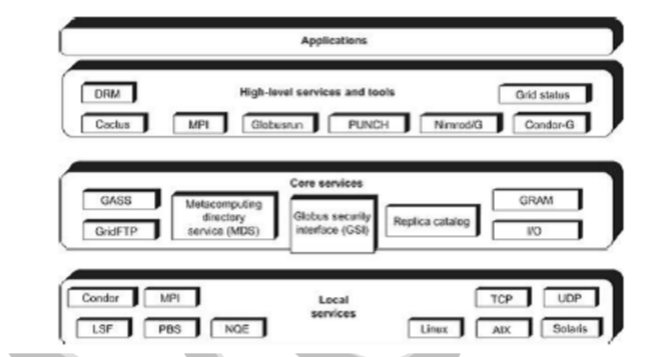
DAS provides the following enhanced categories of accounting functionality to the IPG community: Allows a grid user to request access to a local resource via the presentation of grid credentials Determines and grants the appropriate authorizations for a user to access a local resource without requiring a preexisting account on the resource to govern local […]
Peer to Peer computing is a relatively new computing discipline in the realm of distributed computing. P2P system defines collaboration among a larger number of individuals and/or organizations, with a limited set of security requirements and a less complex resource-sharing topology.
The Open Grid Services Infrastructure (OGSI) was published by the Global Grid Forum (GGF) as a proposed recommendation in June 2003.[1] It was intended to provide an infrastructure layer for the Open Grid Services Architecture (OGSA). OGSI takes the statelessness issues (along with others) into account by essentially extending Web services to accommodate grid computing […]
Open Grid Services Architecture (OGSA) is a set of standards defining the way in which information is shared among diverse components of large, heterogeneous grid systems. In this context, a grid system is a scalable wide area network (WAN) that supports resource sharing and distribution. OGSA is a trademark of the Open Grid Forum.
Schedulers are types of applications responsible for the management of jobs, such as allocating resources needed for any specific job, partitioning of jobs to schedule parallel execution of tasks, data management, event correlation, and service-level management capabilities.
Business On Demand is not just about utility computing as it has a much broader set of ideas about the transformation of business practices, process transformation, and technology implementations. The essential characteristics of on-demand businesses are responsiveness to the dynamics of business, adapting to variable cost structures, focusing on core business competency, and resiliency for […]
The ability to integrate multiple distributed, heterogeneous and independently managed data sources. The ability to provide data catching and/or replication mechanisms to minimize network traffic. The ability to provide necessary data discovery mechanisms, which allow the user to find data based on characteristics of the data.
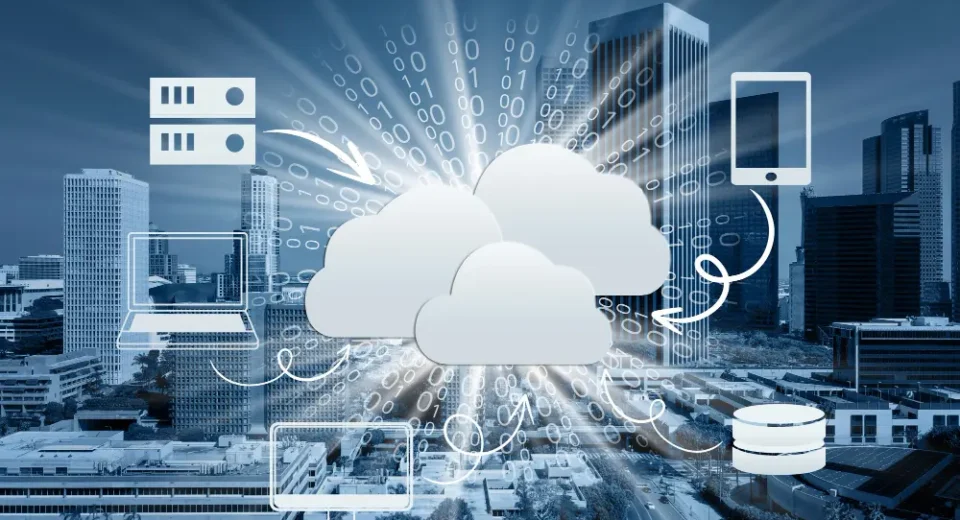
Cloud computing services are divided into three classes, according to the abstraction level of the capability provided and the service model of providers, namely: (1) Infrastructure as a Service, (2) Platform as a Service, and (3) Software as a Service . Figure 1.3 depicts the layered organization of the cloud stack from physical infrastructure to […]
The increasing complexity of computing systems has motivated research on autonomic computing, which seeks to improve systems by decreasing human involvement in their operation. In other words, systems should manage themselves, with high-level guidance from humans . In this sense, the concepts of autonomic computing inspire software technologies for data center automation, which may perform […]