



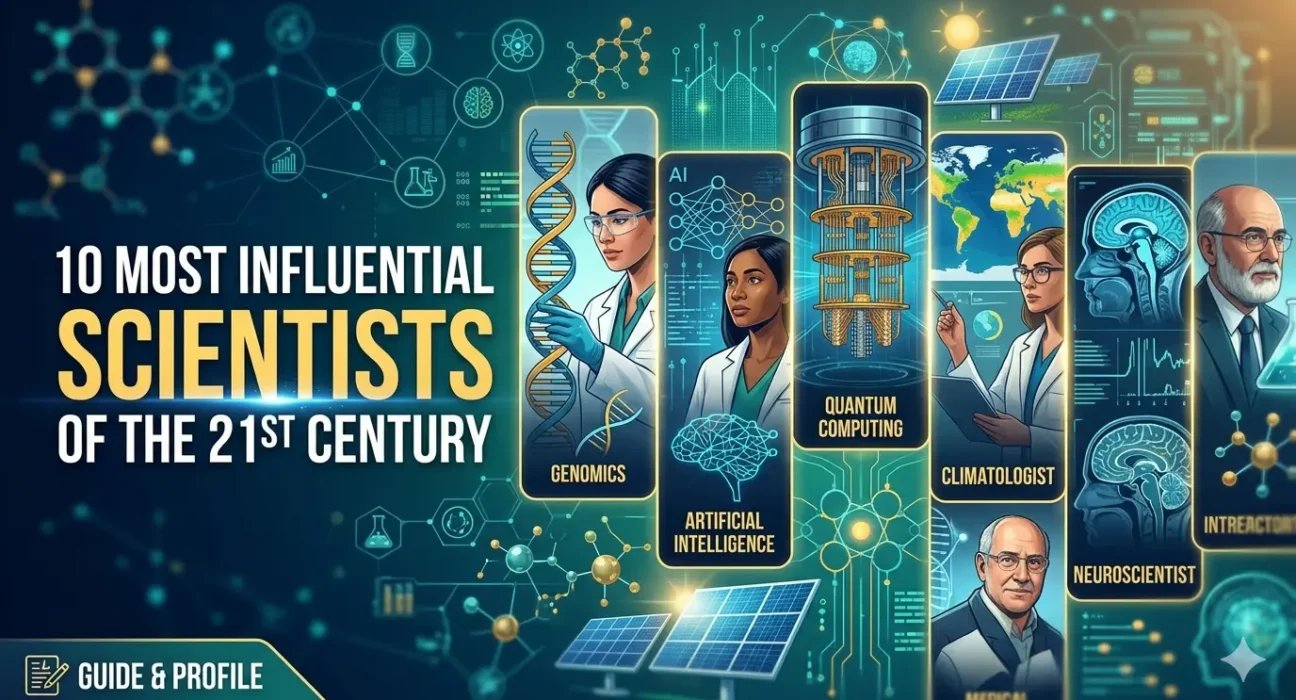
10 Most Influential Scientists of the 21st Century
Science moves fast. In fact, every decade brings discoveries that once seemed completely impossible.
But behind every breakthrough, there is a human story. A scientist who refused to give up. A researcher who questioned everything the world assumed was settled.
The 21st century has already gifted humanity with some of the most remarkable scientific advances in history. We have decoded the human genome. We have edited DNA with surgical precision. Furthermore, we have detected ripples in the very fabric of spacetime.
So who exactly are the people making this happen?
In this article, we explore the 10 most influential scientists of the 21st century — their backgrounds, their discoveries, and why their work matters to you personally.
1. Jennifer Doudna — The Woman Who Rewrote DNA
Field: Biochemistry / Gene Editing Known For: Co-inventing CRISPR-Cas9
Jennifer Doudna changed biology forever. Together with Emmanuelle Charpentier, she developed CRISPR-Cas9 — a gene-editing tool of extraordinary precision. Think of it as a “find and replace” function for the DNA inside living cells.
Before CRISPR existed, editing genes was slow, expensive, and wildly imprecise. Doudna and Charpentier changed all of that. As a result, scientists now use CRISPR to study genetic diseases, develop cancer therapies, and improve crop resistance across the world.
In 2020, both scientists jointly received the Nobel Prize in Chemistry — a historic moment, since it marked the first Nobel awarded to two women simultaneously.
Even today, CRISPR remains one of the most powerful tools in modern medicine. More importantly, Doudna’s work didn’t just advance science — it opened an entirely new chapter of it.
Why It Matters: CRISPR could eventually cure genetic disorders like sickle cell anaemia and cystic fibrosis.
2. Shinya Yamanaka — The Scientist Who Turned Back the Clock on Cells
Field: Regenerative Medicine / Stem Cell Research Known For: Discovering induced pluripotent stem cells (iPSCs)
Here is a fascinating question worth considering: what if you could take an ordinary adult cell and reprogram it to behave like a brand-new stem cell?
Shinya Yamanaka made that possible. In 2006, his team discovered that adult cells can be reprogrammed back into a pluripotent state, meaning one cell type can transform into almost any other cell in the body.
This discovery was genuinely revolutionary. Previously, scientists needed embryonic stem cells — which raised serious ethical concerns — to conduct stem cell research. Thanks to Yamanaka, however, researchers could now use reprogrammed adult cells instead.
As a direct result of this work, he received the 2012 Nobel Prize in Physiology or Medicine.
Moreover, his research now drives advances in personalised medicine, disease modelling, and regenerative therapies that were previously unimaginable.
Why It Matters: iPSC technology could lead to lab-grown organs and personalised drug testing within the next decade.
3. Craig Venter — The Man Who Mapped Human Life
Field: Genomics / Synthetic Biology Known For: Sequencing the human genome; creating the first synthetic cell
In 2000, Craig Venter and his team at Celera Genomics completed a draft of the entire human genome. Without doubt, it was one of the greatest scientific achievements in recorded history.
However, Venter did not stop there. In 2010, his team created the world’s first synthetic cell — a living organism powered entirely by a computer-designed genome. That single moment redefined what life itself means.
Beyond genomics, Venter’s work laid the foundation for personalised medicine, where treatments are tailored to a patient’s exact genetic profile. Additionally, he led a major project to catalogue the genetic diversity of the world’s oceans, uncovering millions of previously unknown species in the process.
Why It Matters: The human genome map gave doctors a powerful new tool for understanding cancer, inherited diseases, and individual drug responses.
4. Kip Thorne — The Physicist Who Heard the Universe
Field: Astrophysics / Theoretical Physics Known For: Detecting gravitational waves
Einstein predicted gravitational waves in 1916. Nevertheless, it took a full century for science to actually detect them.
Kip Thorne played a central role in the LIGO collaboration that finally achieved this in 2015. Gravitational waves are ripples in the fabric of spacetime, caused by massive cosmic events like colliding black holes. Because of this discovery, scientists now have a completely new way to observe the universe — not just by seeing it, but by listening to it.
Thorne consequently shared the 2017 Nobel Prize in Physics for this monumental work. Interestingly, his research also formed the scientific backbone of the film Interstellar, which he co-produced.
Why It Matters: Gravitational wave astronomy is now an entirely new field, helping scientists study black holes and neutron stars with unprecedented clarity.
5. Tu Youyou — The Scientist Who Saved Millions from Malaria
Field: Medicine / Pharmacology Known For: Discovering artemisinin, the world’s most effective malaria treatment
Malaria kills hundreds of thousands of people every year. For decades, existing drugs were losing effectiveness as parasites grew resistant to them.
Tu Youyou found the answer in ancient Chinese medicine. Specifically, she studied thousands of traditional herbal remedies and isolated artemisinin from a plant called sweet wormwood (Artemisia annua). Her unique method of low-temperature extraction preserved the active compound — a breakthrough that earlier researchers had repeatedly missed.
Artemisinin-based therapies now serve as the global standard for treating malaria. Furthermore, they save an estimated one million lives per year in Africa alone.
In 2015, Tu received the Nobel Prize in Physiology or Medicine — making her the first Chinese woman to win a Nobel Prize in science.
Why It Matters: Artemisinin-based treatments are recommended by the WHO and have dramatically reduced malaria deaths worldwide.
6. Emmanuelle Charpentier — Co-Creator of the Gene Editing Revolution
Field: Microbiology / Biochemistry Known For: Co-developing CRISPR-Cas9
While Jennifer Doudna approached CRISPR from a biochemistry angle, Emmanuelle Charpentier arrived at the same breakthrough from a microbiology perspective. Together, their collaboration produced one of the most transformative scientific tools in human history.
Specifically, Charpentier discovered a key molecule — tracrRNA — that plays a critical role in CRISPR’s ability to cut DNA precisely. Without this piece, the gene editing system simply would not function at the level it does today.
As a result, she shared the 2020 Nobel Prize in Chemistry with Doudna. Since then, Charpentier founded the Max Planck Unit for the Science of Pathogens in Berlin, where she continues to study infectious diseases at the molecular level.
Why It Matters: Her foundational work on bacterial immune systems revealed the mechanism that makes CRISPR so precise and scientifically reliable.
7. Frances Arnold — The Scientist Who Taught Evolution to Work for Us
Field: Chemical Engineering / Biochemistry Known For: Pioneering directed evolution of enzymes
Nature took billions of years to evolve enzymes. Frances Arnold, however, figured out how to speed that entire process up dramatically — inside a laboratory.
Her technique, known as directed evolution, mimics natural selection in a controlled lab setting to engineer enzymes with entirely new or greatly improved functions. Because enzymes are biological catalysts that drive chemical reactions in medicines, industrial chemicals, and biofuels, this was a genuinely game-changing development.
Arnold’s method now allows scientists to design enzymes that don’t exist anywhere in nature but are extraordinarily useful to human civilisation. Consequently, in 2018, she became the fifth woman in history to win the Nobel Prize in Chemistry.
Why It Matters: Directed evolution is now used to create greener industrial processes, more effective medicines, and next-generation biofuels at scale.
8. Andrea Ghez — The Astronomer Who Proved Black Holes Are Real
Field: Astrophysics Known For: Proving the existence of a supermassive black hole at the galactic centre
For decades, astronomers strongly suspected that a massive black hole sat at the heart of the Milky Way. Andrea Ghez, however, was the one who actually proved it.
Using the Keck Telescope in Hawaii, Ghez and her team carefully tracked the orbits of stars near the galactic centre over many years. Those stars moved in ways that only one thing could explain — an enormous, invisible mass pulling them with enormous gravitational force. That object is a supermassive black hole called Sagittarius A*.
Not only did this confirm a major prediction of Einstein’s general relativity, but it also transformed how astrophysicists understand galactic structure. As a result, in 2020, Ghez became only the fourth woman in history to win the Nobel Prize in Physics.
Why It Matters: Her work reshaped our understanding of black holes, gravity, and the architecture of our own galaxy.
9. Konstantin Novoselov — The Physicist Behind the Thinnest Material on Earth
Field: Physics / Materials Science Known For: Isolating graphene
Graphene is simply a single layer of carbon atoms arranged in a hexagonal grid. Yet despite its simplicity, this material is 200 times stronger than steel, conducts electricity better than copper, and is nearly transparent — all at once.
What makes Novoselov’s story especially remarkable is how graphene was isolated. Working alongside Andre Geim at the University of Manchester, Novoselov used an astonishingly simple technique — sticky tape and a pencil. By peeling layers of graphite repeatedly, they eventually reached a single atomic layer.
Because of this elegantly simple method, the scientific community took notice immediately. Both scientists subsequently received the 2010 Nobel Prize in Physics for the discovery.
Today, Novoselov continues to lead cutting-edge research on graphene and 2D materials, exploring applications in flexible electronics, energy storage, and biomedical devices.
Why It Matters: Graphene could soon revolutionise electronics, energy generation, and medicine — it is one of the most studied materials in modern science.
10. Robert Langer — The Scientist Who Reinvented Drug Delivery
Field: Biomedical Engineering / Nanotechnology Known For: Pioneering controlled drug delivery and enabling mRNA vaccine technology
Robert Langer holds over 1,400 patents — more than almost any living scientist on the planet. His work sits precisely at the intersection of engineering and medicine, and it has touched the lives of hundreds of millions of people.
His most celebrated contribution is the development of controlled drug delivery systems — technologies that allow medicine to release into the body slowly and at exactly the right rate, rather than flooding the system all at once. Because of this innovation, many cancer drugs, contraceptive implants, and wound-healing therapies now work far more effectively.
Furthermore, Langer co-founded the company that developed the lipid nanoparticle delivery system used in mRNA vaccines. In other words, the same technology that made the COVID-19 vaccines possible traces directly back to his work.
Why It Matters: Langer’s innovations directly enabled the mRNA vaccines that helped humanity navigate the COVID-19 pandemic.
What These Scientists Have in Common
Each name on this list shares a few defining traits. First, they were curious when others were comfortable with existing answers. Second, they persisted through years of unclear, inconclusive results. Third, and perhaps most importantly, they shared their knowledge openly — often building communities around their work rather than guarding it.
Moreover, none of them worked in total isolation. Every discovery builds on thousands of previous ones made by researchers who came before. That collaborative spirit, above all else, is what drives science forward.
Frequently Asked Questions (FAQ)
Q1. Who is the most influential scientist of the 21st century? Jennifer Doudna is widely considered among the most influential scientists of this century. Her co-invention of CRISPR-Cas9 has reshaped medicine, agriculture, and biological research in ways that continue to unfold.
Q2. Which 21st century scientists won the most impactful Nobel Prizes? Several scientists on this list received Nobel recognition. These include Doudna and Charpentier (2020, Chemistry), Kip Thorne (2017, Physics), Shinya Yamanaka (2012, Medicine), Frances Arnold (2018, Chemistry), Andrea Ghez (2020, Physics), and Tu Youyou (2015, Medicine).
Q3. Are there any Indian scientists among the most influential of this century? This list focuses on specific global breakthrough discoveries. However, Venkatraman Ramakrishnan — who won the 2009 Nobel Prize in Chemistry for ribosome research — and C.N.R. Rao, a leading figure in materials science, rank among the most influential Indian scientists of this era.
Q4. Which field produced the most breakthrough scientists in the 21st century? Biochemistry, genetics, and medicine have produced the highest concentration of transformative scientists in this period. The CRISPR revolution, iPSC research, and human genome sequencing have together driven enormous progress.
Q5. Why is CRISPR considered the most important scientific development of the 21st century? CRISPR-Cas9 allows precise, affordable, and fast gene editing. As a result, it holds potential for treating genetic diseases, strengthening food security, and making personalised medicine a realistic option for patients worldwide.
Conclusion
The scientists on this list did not merely make discoveries — they fundamentally changed what is possible for humanity.
From editing the code of life to detecting the sound of two black holes colliding a billion light-years away, these breakthroughs remind us powerfully of what human curiosity can achieve.
Science, after all, is not a fixed body of facts. Instead, it is a living, growing, sometimes messy process — driven entirely by people who choose to ask better questions.
The 21st century is still young. And the next great discovery could already be underway in a laboratory somewhere right now.