




DISHONOUR
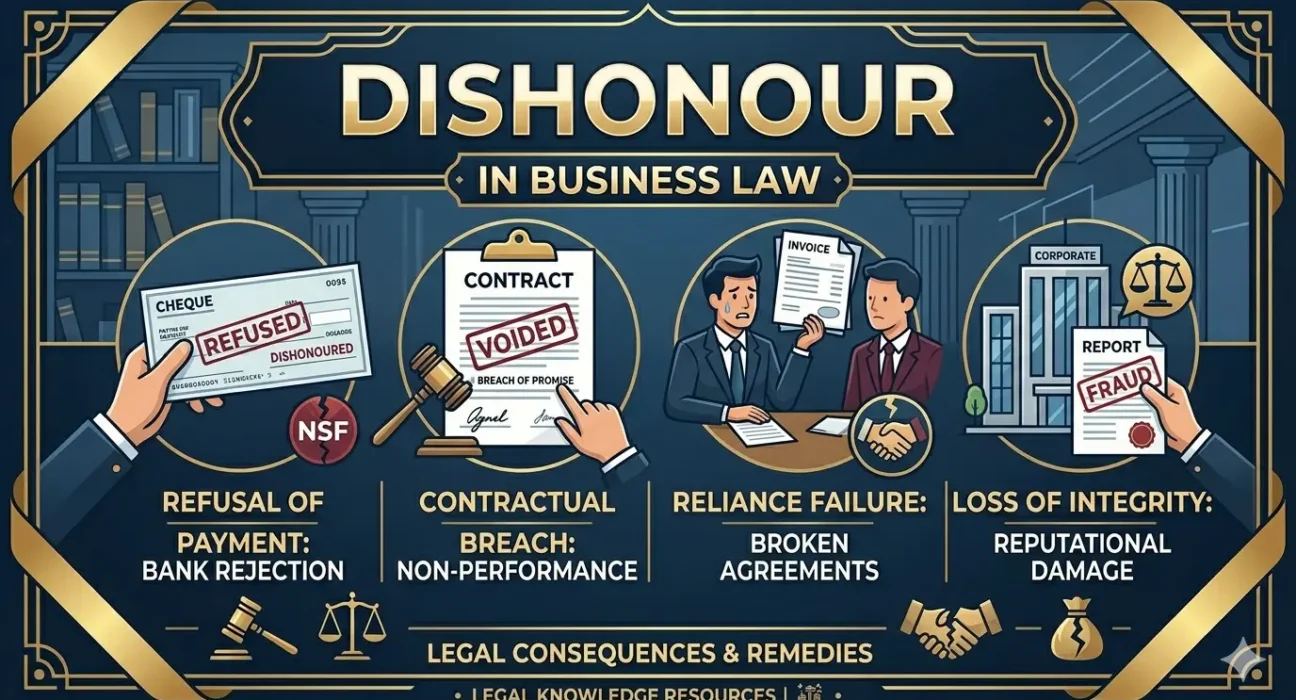
Dishonour is the refusal or failure to accept or pay a negotiable instrument when it is properly presented for acceptance or payment. In business law, the concept primarily applies to instruments such as a Cheque, Bill of Exchange, and Promissory Note.
A negotiable instrument is said to be dishonoured when the person who is legally required to accept or pay it fails or refuses to do so according to its terms.
Types of Dishonour
There are two main types of dishonour:
1. Dishonour by Non-Acceptance
A bill of exchange is dishonoured by non-acceptance when the drawee refuses to accept it or fails to give acceptance within the prescribed time.
A bill may be dishonoured by non-acceptance in situations such as:
- The drawee refuses to accept the bill.
- The drawee cannot be found after reasonable search.
- The drawee is incompetent to contract, such as being a minor.
- The drawee gives a qualified or conditional acceptance instead of an unconditional acceptance.
- Several drawees are named, and not all of them accept the bill.
Effect:
Once a bill is dishonoured by non-acceptance, the holder can immediately take legal action against the drawer and endorsers without waiting for the due date.
2. Dishonour by Non-Payment
A negotiable instrument is dishonoured by non-payment when the maker, acceptor, or drawee fails to make payment on the due date.
Examples include:
- A cheque is returned due to insufficient funds.
- The acceptor of a bill refuses to pay at maturity.
- The maker of a promissory note fails to pay the amount due.
- The account on which the cheque is drawn is closed.
Effect:
The holder acquires the right to recover the amount from parties liable on the instrument, subject to giving proper notice of dishonour.
Notice of Dishonour
When a negotiable instrument is dishonoured, the holder is generally required to give a notice of dishonour to the drawer and endorsers.
Purpose of Notice
- To inform liable parties that the instrument has been dishonoured.
- To preserve the holder’s right to recover the amount from those parties.
- To allow the parties to make arrangements for payment.
Modes of Giving Notice
Notice may be:
- Oral or written.
- Sent by post, courier, or electronic means where permitted.
- Given by the holder or by any party liable on the instrument.
Cases Where Notice Is Not Necessary
Notice of dishonour is not required in certain situations, such as:
- The drawer has countermanded payment.
- The drawer could not suffer damage due to lack of notice.
- The party entitled to notice waives it.
- The drawer and drawee are the same person.
- The party cannot be found after reasonable search.
Dishonour of Cheques
In modern commercial practice, dishonour most commonly relates to cheques.
A cheque may be dishonoured for reasons such as:
- Insufficient balance in the account.
- Signature mismatch.
- Overwriting or material alteration.
- Stale cheque (presented after its validity period).
- Post-dated cheque presented before its date.
- Account closed or frozen.
- Stop-payment instructions issued by the drawer.
Legal Consequences of Dishonour
The consequences of dishonour can be significant:
- Civil Liability
- The holder can sue for recovery of the amount due along with interest and costs.
- Criminal Liability
- In many jurisdictions, dishonour of a cheque for insufficient funds may attract criminal penalties if statutory conditions are met.
- Loss of Business Reputation
- Repeated dishonour of instruments can adversely affect a person’s or business’s creditworthiness and reputation.
- Bank Charges
- Banks often levy dishonour or return charges when a cheque or payment instruction is returned unpaid.
Example
Suppose A issues a cheque for ₹1,00,000 to B for payment of goods purchased.
- B presents the cheque to the bank.
- The bank returns it unpaid because A’s account has only ₹20,000.
- The cheque is said to be dishonoured by non-payment.
- B may issue a notice to A and initiate legal proceedings to recover the amount, subject to the applicable law.