


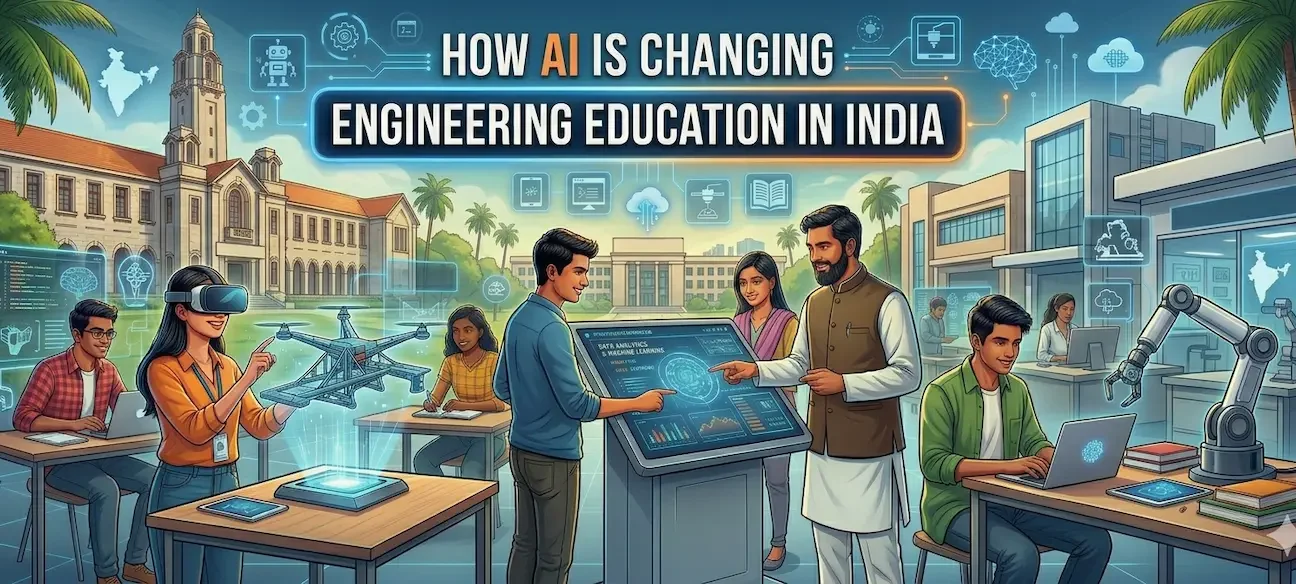
How AI is Changing Engineering Education in India
Picture a civil engineering student designing a smart bridge. She is not using a ruler or a drawing board. Instead, she runs an AI simulation, feeds in load data, and watches the structure respond — adjusting, failing, and improving — all inside a virtual environment.
That scenario is not a dream. That is engineering education in India in 2026.
Artificial Intelligence has stopped being a subject confined to computer science departments. Today, it shapes how every engineering student learns, practises, builds, and prepares for a career. Furthermore, the change is no longer limited to elite campuses in Chennai or Mumbai. It is spreading rapidly into tier-2 cities, state colleges, and even districts that most people would never associate with cutting-edge technology.
So what has actually changed? And more importantly, what does it mean for you as a student or a parent trying to make sense of this new landscape?
Let us break it down clearly.
India’s Engineering Problem — And Why It Demanded a Real Fix
Before understanding the solution, you need to understand the scale of the problem.
India trains more engineers every year than almost any other country on earth. Yet for decades, a massive gap existed between what colleges taught and what industries actually needed. Graduates arrived at interviews able to recite formulas but unable to solve real problems. Companies spent months retraining fresh recruits before those recruits could contribute meaningfully.
The result was a quiet crisis. Talented young people with engineering degrees found themselves underemployed. Meanwhile, companies struggled to fill genuinely skilled positions even as millions of graduates searched for work.
Something clearly had to change. Not a minor curriculum tweak — a fundamental rethinking of how engineering education delivers value.
That rethinking is happening right now, in 2026. And AI is the central instrument driving it.
From Theory-Heavy to Skill-First — The Shift That Defines 2026
The most significant change happening across Indian engineering colleges in 2026 is a move away from passive, theory-heavy learning toward active, skill-first education.
For decades, engineering students memorised concepts for exams. They reproduced formulas on paper and forgot them within weeks. Practical sessions were limited, often because labs lacked equipment, chemicals, or functioning instruments.
AI has begun dismantling that model systematically.
Adaptive learning platforms now identify exactly where each student struggles. Instead of delivering the same lecture to sixty students at different levels of understanding, these platforms serve each student a personalised path. A student who masters thermodynamics quickly gets pushed into more advanced applications. Another student who struggles with the same concept receives additional examples, simpler analogies, and practice problems pitched at the right difficulty level.
Moreover, AI-powered assessment tools give students feedback immediately after they submit work — not weeks later when a corrected paper finally comes back. That immediacy changes how students engage with their own learning. Mistakes become learning moments rather than marks lost on a transcript.
Consequently, the quality of understanding that students carry out of the classroom is meaningfully deeper than it was under the old model.
Virtual Labs — The Most Practical Revolution Nobody Talks About
If there is one AI-driven development in Indian engineering education that deserves far more attention than it currently receives, it is the rise of virtual labs.
Here is the reality for most engineering colleges outside the top twenty institutions. Physical labs are expensive. Equipment breaks. Chemicals run out. Safety rules restrict what experiments students can actually perform. Many students graduate having never conducted certain experiments at all — simply because the resources were not available.
Virtual labs solve every one of these problems simultaneously.
A mechanical engineering student can simulate an engine running at extreme temperatures without a physical engine. An electrical engineering student can test circuit configurations that would be dangerous or impossible in a real lab environment. A chemical engineering student can observe reactions at the molecular level that no physical lab could safely demonstrate.
Beyond safety and cost, virtual labs offer something physical labs never could — the freedom to fail repeatedly without consequence. Students can try an approach, watch it fail, understand why, adjust, and try again. That iterative cycle of testing and learning is precisely how engineers develop genuine problem-solving instincts. In 2026, AI makes that cycle available to every student with a laptop and an internet connection.
Smart Classrooms — When the Classroom Learns Too
The phrase “smart classroom” has been overused for years. In 2026, however, it describes something genuinely different from a projector and a speaker system.
Modern smart classrooms use IoT sensors, facial recognition tools, and engagement analytics to collect real-time data about what is happening in a learning environment. When thirty students sit in a lecture on fluid mechanics, the system tracks which ones are disengaged, which sections of content trigger confusion, and which students are processing material too slowly to keep up.
The professor no longer needs to guess. The data surfaces insights immediately. As a result, teaching becomes responsive rather than scripted. A professor can slow down mid-lecture, switch to a different explanation style, or identify students who need one-on-one support before they fall behind entirely.
For students, this means fewer “lost weeks” — those stretches where a student misunderstands a foundational concept early in the semester and spends the rest of the term building on a shaky base. Smart classrooms catch those gaps early and flag them for correction before they compound.
Generative AI — A Study Partner That Never Sleeps
One of the most widely used AI tools among Indian engineering students in 2026 is not a specialised engineering platform. It is Generative AI — tools like large language models that can explain concepts, generate code, debug logic, and answer follow-up questions at any hour of the day or night.
Global data shows that student AI tool usage jumped from 66% in 2024 to 92% in 2025. By early 2026, the figure is approaching universal adoption among college students. Indian engineering students are very much part of that trend.
Used well, Generative AI is an extraordinary learning accelerator. A student stuck on a data structures problem at 11 PM no longer has to wait until the next tutorial session. They can work through the concept interactively, ask follow-up questions in their own words, and arrive at genuine understanding rather than just copying a solution.
Used poorly, however, Generative AI becomes a crutch. Students who outsource their thinking entirely — submitting AI-generated assignments without engaging with the underlying concepts — graduate with weaker problem-solving skills, not stronger ones. Research from MIT found that students who depended heavily on external tools showed measurably different brain connectivity patterns compared to those who worked through problems independently.
The best engineering colleges in India are now building AI literacy into their curriculum — teaching students not just how to use these tools, but when to use them, when to put them down, and how to verify what they produce.
That distinction is becoming a defining competency for the next generation of engineers.
AI Across Every Engineering Branch — Not Just CSE
Perhaps the most important structural change in 2026 is that AI is no longer exclusively a Computer Science Engineering topic.
Civil engineering students learn how machine learning models predict structural stress in bridges and buildings. Mechanical engineering students use AI to model predictive maintenance schedules that prevent factory downtime. Electrical engineering students apply AI to smart grid management, where algorithms balance power distribution across millions of consumers in real time. Biotechnology students use AI to analyse genetic sequences faster than any human researcher ever could.
This cross-disciplinary integration matters enormously because it mirrors how industry actually works. No modern infrastructure project, manufacturing plant, or healthcare system runs without some layer of AI integration. Engineers who understand only the mechanical or electrical side of a system — without any fluency in the AI layer sitting on top — are already at a disadvantage in the job market.
In 2026, India’s regulatory bodies have recognised this clearly. The move to embed AI-specific modules into every engineering discipline — not just as optional electives but as core curriculum components — reflects a belated but decisive acknowledgement that AI literacy is now a fundamental engineering skill.
What Industry Is Actually Saying in 2026
The India Skills Report 2026 — one of the most comprehensive workforce surveys conducted annually — puts the employment picture in sharp focus.
National employability has risen from 46.2% in 2022 to 56.3% in 2026. That is meaningful progress. Nevertheless, 43.7% of Indian graduates still struggle to meet employer expectations — which means the work is far from complete.
The same report notes that India now commands 16% of the global AI talent pool, a figure expected to reach 1.25 million professionals by 2027. AI, data analytics, cloud computing, and cybersecurity have emerged as the four most in-demand skills across every major hiring sector — technology, banking, manufacturing, renewable energy, and healthcare.
For engineering students, this translates into a clear message. Technical domain knowledge matters. However, technical domain knowledge combined with AI fluency is what makes a graduate genuinely competitive in 2026.
Entry-level AI engineers in India currently earn between ₹6 lakh and ₹12 lakh per annum. Those with three to five years of experience move into the ₹15 to ₹30 lakh range. Senior specialists in deep learning, computer vision, or natural language processing regularly attract packages of ₹40 lakh and above — with global companies offering significantly more for exceptional talent.
The financial signal is unambiguous. AI skills translate directly into higher starting salaries and faster career progression.
The AI-First College — A New Kind of Institution
A new category of engineering institution is emerging in India in 2026 — the AI-first college.
This is not simply a college that offers a BTech in AI. Nearly every institution in the country offers that now. An AI-first college is one that has restructured its entire academic operation around AI as a foundational tool.
Admissions processes use AI to match student profiles with programmes where they are most likely to thrive. Faculty receive AI-generated dashboards showing exactly which students are at risk of falling behind and in which topics. Research teams use AI to accelerate literature reviews, data analysis, and manuscript preparation. Administrative workflows — scheduling, grievance redressal, examination management — run through AI-assisted systems that reduce processing time and human error.
In such institutions, AI is not a department or a course. It is the operating layer on which everything else runs.
This model represents the most ambitious interpretation of what AI can do for engineering education. However, it also requires significant investment, strong leadership, and a willingness to redesign processes that institutions have used for decades. Consequently, only a small number of forward-thinking colleges have reached this level in 2026 — but their early results are drawing significant attention from both students and policymakers.
The Challenges That Honest Reporting Cannot Ignore
Progress is real. However, it is not uniform, and pretending otherwise would mislead the very students who need accurate information.
The gap between well-funded urban colleges and rural or semi-urban institutions remains significant. High-performance computing infrastructure is expensive. Reliable, high-speed internet is still not available in every district. Many tier-3 colleges lack the technical faculty needed to teach AI concepts at a meaningful depth — not because those teachers lack intelligence, but because they were trained in a pre-AI era and have not yet had access to adequate retraining programmes.
Beyond infrastructure, there is a deeper cultural challenge. Moving from rote memorisation to project-based, exploratory learning requires a shift in mindset from students, parents, and educators simultaneously. Many students still equate studying with copying notes. Many parents still measure a college’s quality by its pass percentage rather than its placement quality or its curriculum relevance. Changing those deeply embedded expectations takes time and sustained communication — more than any single policy announcement can deliver.
Furthermore, there is the dependency risk. Students who learn to rely entirely on AI tools for problem-solving may graduate technically credentialed but intellectually underprepared. The engineers most valued by industry in 2026 are not those who use AI most frequently — they are those who use AI most intelligently, knowing when to trust the output, when to question it, and when to put the tool aside and reason through a problem independently.
What Engineering Students Must Do Differently Right Now
If you are currently pursuing a BTech degree in India, the landscape around you is changing faster than any curriculum can track. Here is the practical guidance that actually matters in 2026.
Build with real data. Certificates and course completions tell recruiters what you studied. Projects tell them what you can do. Find a real dataset — agricultural yield data, traffic patterns, medical records — and build something useful from it. Document it. Deploy it. Share it publicly.
Learn the tools industry actually uses. Python remains the most important language for AI and data work. Cloud platforms — whether AWS, Google Cloud, or Azure — are now expected knowledge at entry level. Version control through Git is non-negotiable. These are not optional additions to your skill set. They are baseline competencies that every competitor for your next job will also have.
Understand your domain first. AI without domain knowledge is just code. A mechanical engineer who understands thermodynamics deeply will build far better predictive maintenance models than a programmer who understands neural networks but has never seen a factory floor. Your engineering fundamentals are not obstacles to AI learning — they are the context that makes your AI work genuinely valuable.
Stay current independently. Your college curriculum will always lag behind industry by two to three years. That is simply the pace at which academic institutions move. Reading research papers, following AI communities online, and experimenting with new tools on your own time bridges that gap. The students who thrive in 2026 are those who supplement their formal education with self-directed learning consistently.
Frequently Asked Questions (FAQ)
Q1. How is AI specifically changing engineering education in India in 2026? AI is changing engineering education across multiple dimensions simultaneously — personalised learning paths that adapt to each student’s pace, virtual labs that make expensive experiments accessible to everyone, smart classrooms that give teachers real-time insight into student comprehension, and AI-embedded curricula across every engineering discipline, not just computer science.
Q2. Do all engineering students in India need to learn AI, even in non-CSE branches? Yes. In 2026, AI is no longer a CSE-exclusive skill. Civil engineers use AI for structural analysis and smart infrastructure. Mechanical engineers apply it to predictive maintenance and manufacturing automation. Electrical engineers use it in smart grid management. Every engineering branch now has AI-specific applications that industry expects graduates to understand.
Q3. What salary can an AI engineering graduate expect in India in 2026? Entry-level AI engineers in India earn between ₹6 lakh and ₹12 lakh per annum. Mid-level professionals with three to five years of experience earn ₹15 to ₹30 lakh. Senior specialists in deep learning, computer vision, or NLP regularly attract packages of ₹40 lakh and above, with top global companies offering significantly higher compensation for exceptional candidates.
Q4. What is the biggest mistake Indian engineering students make with AI tools? Over-reliance is the most common and most damaging mistake. Using AI to complete assignments without engaging with the underlying concepts produces graduates who are credentialed but underprepared. The most valuable engineers in 2026 are those who use AI intelligently — knowing when to trust it, when to question it, and when to work through a problem without it.
Q5. How can a student at a tier-2 or tier-3 college access quality AI education in 2026? Quality AI education is increasingly available beyond elite institutions. Free platforms offering professional-grade AI courses, open-source tools like Python and TensorFlow, cloud platforms with student access programmes, and virtual lab environments accessible via laptop and internet connection collectively give motivated students at any institution access to world-class learning resources. Initiative matters more than college tier in 2026.
Q6. Is the engineering employability crisis in India improving because of AI education? Partially. National employability rose from 46.2% in 2022 to 56.3% in 2026 — meaningful progress. However, over 43% of graduates still do not meet industry expectations. The improvement is real, but the gap remains large. Colleges that combine AI tools with strong fundamentals and project-based learning are producing notably stronger placement outcomes than those that have simply added AI course names to an otherwise unchanged curriculum.
Conclusion
Engineering education in India is not just adopting new technology. It is rethinking what an engineer needs to know, what an engineer needs to be able to do, and how education can actually deliver both of those things in a world that changes faster than any fixed curriculum can track.
In 2026, AI is the most powerful instrument that transformation has access to. Virtual labs are closing the infrastructure gap. Smart classrooms are making teaching responsive rather than scripted. Generative AI is giving students a study partner available at every hour. Cross-disciplinary AI integration is ensuring that civil, mechanical, electrical, and biotechnology students leave college with skills that industry actually needs.
Nevertheless, technology does not fix everything by itself. The students who will genuinely benefit from this transformation are those who engage with it actively — who build real projects, develop strong fundamentals, and learn to use AI as a tool that amplifies their thinking rather than replaces it.
India has the talent. The infrastructure is improving. The policy commitment is clearer than ever. What happens next depends on how individual students choose to engage with the opportunities now in front of them.
The classroom of 2026 is a different place from the classroom of 2016. The engineers who thrive in the decade ahead will be the ones who recognise that difference — and act on it.